How to Turn Judge.me Reviews Into Better Shopify Product Descriptions
Your Judge.me reviews contain the words that sell your product. How to mine them and rewrite your Shopify product descriptions — by hand or automatically.

You already paid for the best copy on your product page. It is sitting a few hundred pixels below it, in the review widget.
Most Shopify merchants treat Judge.me as a trust badge: collect reviews, display stars, move on. That is a fair use of it. But it means the single richest source of language about your product — written by people who actually bought it, in the words they actually use — never makes it into the description that has to do the selling.
This guide covers how to change that. First the manual method, which is free and which you should try on one product before anything else. Then where it breaks down, and what to do about it.
Why Review Text Beats a Blank AI Prompt
Ask a general-purpose AI tool to write a product description and it will give you a fluent, generic paragraph assembled from everything it has read about products in that category. It is grammatically perfect and says nothing specific.
The problem is not the model. It is the input. The model has no idea that 40% of your buyers mention the same sizing quirk, that your product keeps getting bought as a gift, or that the one complaint that keeps recurring is about the packaging rather than the product.
Your reviews know all of that. They are first-party data about your specific product, from your specific customers, and they contain three things a blank prompt cannot:
The vocabulary your buyers actually use. Not the industry term, the shopper's term. If every reviewer calls it a "travel mug" and your description says "insulated vessel", you have a mismatch that costs you both search traffic and the half-second of recognition a shopper needs to feel they are in the right place.
The objections that stop a purchase. Negative and three-star reviews are a free list of everything that makes a buyer hesitate. A description that answers a known objection before it is raised converts better than one that leaves the shopper to find it in the reviews themselves.
The use cases you did not design for. Buyers routinely find uses you never advertised. Those are new angles, and sometimes new keywords, that no amount of brainstorming would have surfaced.
What You Are Actually Looking For
Before you open anything, know what you are mining for. Reading reviews without a structure just produces a vague feeling that people mostly like it.
Work through four buckets:
Praise themes. What do people compliment, and how often? Not the five-star rating — the specific attribute. Count them. Three mentions of "arrived faster than expected" is noise; thirty is a selling point that belongs above the fold.
Objection themes. What do the two- and three-star reviews keep returning to? Separate genuine product problems (fix the product) from misunderstandings and mismatched expectations (fix the description).
Vocabulary. Write down the exact nouns and adjectives that repeat. These are your keyword candidates and your copy, at the same time.
Gaps. What do reviewers ask or clarify that your description never mentioned? Every "I wish I had known that" is a missing line in your copy.
The Manual Method: Five Steps
Do this once, by hand, on your best-selling product. It takes about an hour and it will teach you more about your copy than any guide, including this one.
Step 1 — Export the reviews. In your Judge.me admin, find the import/export area and export your reviews to CSV. Judge.me has moved this between Settings and the reviews dashboard across versions, so check both. Pull everything for a single product, not your whole store. Mixing products destroys the pattern.
Step 2 — Split by rating. Put five- and four-star reviews in one column, three-star and below in another. These answer different questions and should not be read together. The high ratings tell you what to lead with; the low ones tell you what to defuse.
Step 3 — Tally the themes. Go through each column and tag every review with a short theme label — "sizing", "battery life", "packaging", "gift". Reuse labels aggressively. When you are done, count them and sort. The top three to five themes in each column are what matter; the long tail is noise.
Step 4 — Pull the exact phrasing. For each top theme, copy two or three of the clearest sentences reviewers wrote. Do not paraphrase yet. You want their words on the page in front of you, because the whole point is to stop writing in your own voice and start writing in theirs.
Step 5 — Rewrite the description. Lead with the strongest praise theme in the buyer's vocabulary. Address the top one or two objection themes in the body, directly and without defensiveness. Fill every gap you found. Keep the structure your theme expects — heading, short paragraphs, bullets for scannable specs.
One rule throughout: do not drop a named customer's review verbatim into the description as if it were your own marketing copy. Work from the themes and the shared vocabulary. Testimonials belong in the review widget, where they are attributed and where shoppers trust them precisely because they are not marketing copy.
Where the Manual Method Breaks
The method above works. The problem is that it works for one product.
With 20 products, that hour becomes a week. With 200, it never happens at all. And it is not a one-off job — reviews keep arriving, themes shift when you change a supplier, and a description written from last year's reviews slowly drifts out of sync with what buyers are currently saying.
This is the point where most merchants quietly stop. The spreadsheet from the first product sits in a folder, the other 199 descriptions stay as they were, and the reviews go back to being a trust badge.
The Automated Method
Descripio exists to run exactly the process above at catalog scale. It is a Shopify app with a native Judge.me integration, which means it reads your reviews directly once you connect it — no CSV export, no copy-paste, no manual tagging.
The pipeline mirrors the manual steps:
Connect. You add your Judge.me store credentials once in the app settings; they are encrypted per shop. From then on Descripio reads reviews for any product you select.
Analyze. It extracts themes from your review text the same way you would by hand — praise, issues, missing details — and clusters them by frequency, so you see the pattern rather than individual opinions. A vision model checks your product images against the same themes, which catches the common case where buyers keep asking about something that is genuinely not visible in any photo.
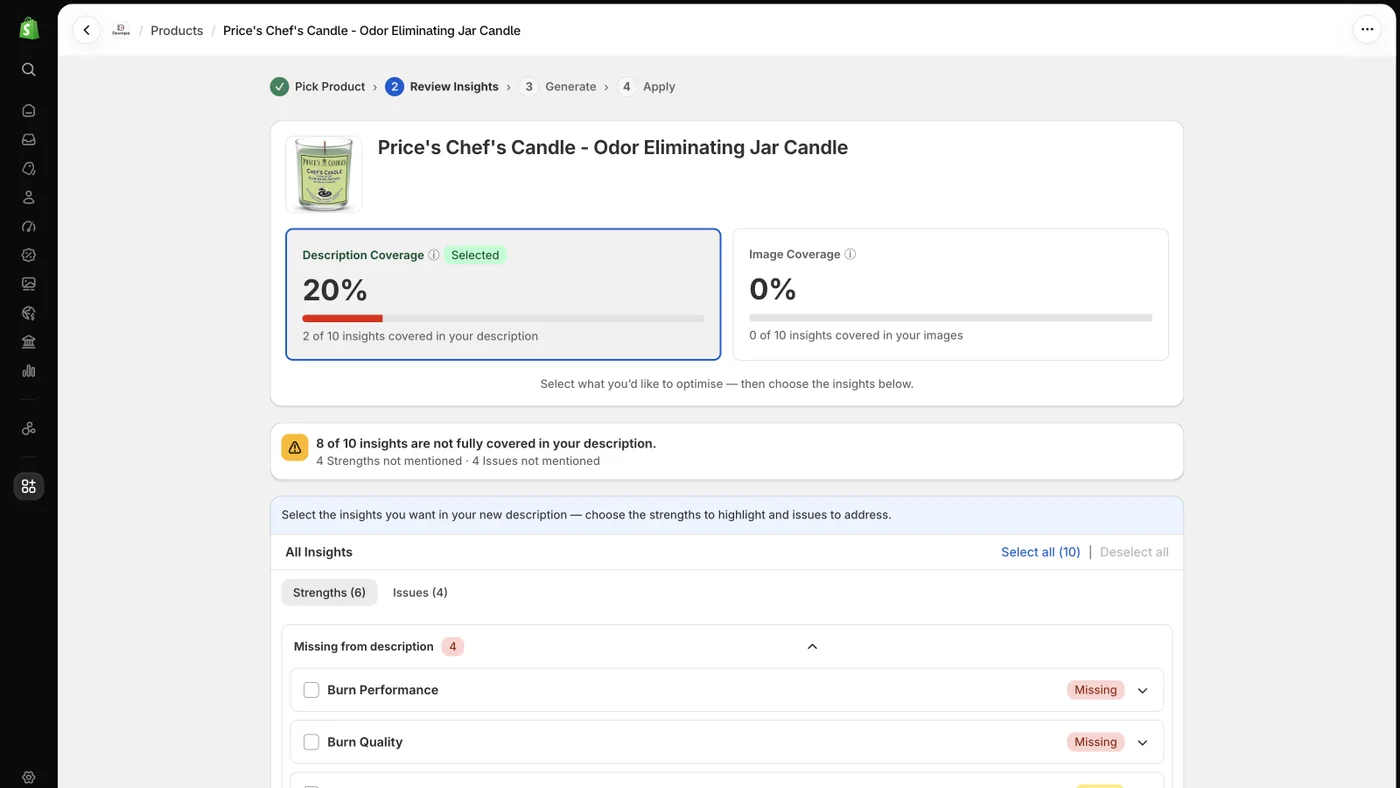
Choose, generate, publish. You decide what the description should address — strengths, issues, gaps, image problems — and it writes an SEO-ready description from those themes. You edit it and keep control of what ships; one click writes it back to your Shopify product page through the official Shopify API.
If you also sell the same or a comparable product on Amazon, you can combine both sources — Judge.me reviews from your own store plus Amazon reviews via an ASIN — and get themes synthesized across both. Amazon review volume is usually an order of magnitude higher, which makes the themes considerably more reliable.
The free plan covers five products per month, which is enough to test the approach on real products before paying for anything.
No Reviews Yet?
The obvious objection to all of this: it requires reviews. A new store, or a newly launched product, has none.
For that case Descripio queries what large language models already know about your product category — what buyers in that category typically praise and typically complain about — and feeds those themes into the same pipeline. It is a weaker signal than your own customers, and it should be treated as a starting point rather than a verdict.
One guardrail worth stating plainly, because it is a real compliance line: AI-derived themes are never presented as customer quotes. They are category knowledge, labeled as such. Attributing a generated sentence to a customer who does not exist is a straightforward consumer-protection problem, and no conversion gain is worth it.
A Worked Example
Here is what the gap actually looks like on a real product — a jar candle sold as an odour eliminator for kitchens and homes.
The description it ships with today:
Transform your kitchen and home with Price's Chef's Candle, specially designed not only to eliminate unwanted cooking and pet odors but also to enhance your overall ambiance with a fresh, clean atmosphere.
Cuisine de Chef — Eliminates Odours This premium jar candle is expertly crafted with natural extracts that neutralize odors rather than simply masking them, ensuring your home smells fresh and inviting. Users love how it effectively eliminates odor, stating, "My kitchen has never smelled fresher!"
Natural Ingredients Made with a carefully balanced blend of: Basil extract — fresh, herbaceous notes. Patchouli — earthy, grounding aroma. Geranium — floral, uplifting fragrance.
That is a perfectly decent description. It is specific about the ingredients, it leads with the core benefit, and it even borrows one line from a review — "My kitchen has never smelled fresher" is a sentence a real customer wrote.
What the reviews actually contain:
Run the same product through a review analysis and ten distinct themes come back — six strengths and four issues. The description above covers two of them. Eight do not appear anywhere on the page.
| Theme | In the description? |
|---|---|
| Scent Characteristics | ✅ Covered |
| Scent Quality | ✅ Covered |
| Burn Performance | ❌ Missing |
| Burn Quality | ❌ Missing |
| Odor Neutralization Efficacy | ⚠️ Partial |
| Product Design and Durability | ❌ Missing |
| Combustion Issues | ❌ Not addressed |
| Fragrance Performance Deficiencies | ❌ Not addressed |
| Physical Design Limitations | ❌ Not addressed |
| Scent Effectiveness | ❌ Not addressed |
Look at what that pattern says. The description talks confidently about scent — the thing the copywriter could describe from the product brief alone. It says almost nothing about burn performance, burn quality or durability, because those only become visible once people have actually burned the candle for a few weeks. Those are precisely the things reviewers kept writing about, and precisely the things a prospective buyer is trying to find out.
And all four recurring complaints — combustion problems, fragrance fading, physical design limits, how long the odour-eliminating effect lasts — are unaddressed. A shopper who scrolls past the description into the reviews meets every one of them unprepared.
The image side is worse: zero of the ten themes are visible in the product photography. One photo of the jar, no burn shot, nothing showing the wick, the wax pool, or the candle in a kitchen.
What the rewrite should do, in the order the themes rank: lead with scent (already working), then add the burn performance and burn quality evidence that is currently missing, state the realistic odour-neutralising duration rather than leaving it vague, and address the combustion and fragrance-fade complaints directly instead of letting the review section raise them first.
What a rewrite that used all ten themes would look like:
Price's Chef's Candle — Odour-Eliminating Jar Candle for Kitchens and Pet Homes
Cooking smells and pet odours do not stay politely in one room. This jar candle is made to neutralise them rather than cover them, using a natural extract blend: basil for fresh, herbaceous top notes, patchouli for an earthy base, geranium for a soft floral lift. The scent reads as natural rather than synthetic — which is the difference between masking a kitchen and actually clearing it.
How it burns Give the first burn two to three hours, long enough for the wax to melt right out to the edge of the glass. That first full melt pool is what stops the candle tunnelling down the middle later and wasting half the wax. Trim the wick to about 5 mm before every lighting: it keeps the flame steady, stops the glass sooting, and gives you an even burn to the bottom of the jar.
What to expect from the scent This is a room candle, not an air purifier. In a normal kitchen or living room it holds its own against cooking and pet smells while it burns and for a while afterwards. In a large open-plan space, or against odour that has had time to settle into soft furnishings, one candle will not be enough — burn two, or burn it while you cook rather than after. The throw is steady rather than overpowering, by design.
The jar and the lid Heavy glass jar with a fitted lid. Keep the lid on between burns — it is what stops the fragrance evaporating away while the candle sits on the shelf, and it is the main reason the scent is still there on the last burn. The jar is a deliberate size: enough burn life for regular kitchen use, small enough to sit on a worktop without taking it over. Once the wax is gone, warm water lifts the remainder and the jar is reusable.
Compare that with the original. Same product, same ingredients, roughly the same length — but it now answers burn behaviour, tunnelling, scent fade, room size and the lid, all of which were sitting in the reviews and none of which were on the page.
Two things that version deliberately does not do. It does not quote a named reviewer as if the sentence were marketing copy. And it does not claim an odour-elimination result it cannot support — it states where the candle works and, just as plainly, where it does not. An honest limit builds more trust than an unbounded claim, and it stops the review section from being the first place a shopper hears about it.
A note on this example: the rewrite above is our own, written against the ten themes to show what "addressing the insights" means in practice. It is not a verbatim tool output. If you adapt it, substantiate the specifics — burn times, coverage, jar size — against your own product and reviews rather than copying ours.
Final Thoughts
The gap between a generic product description and a good one is rarely talent. It is input. Most descriptions are written before the product has any customers, by someone guessing at what buyers will care about, and then never revisited once actual buyers start telling you the answer in writing.
Start with one product. Export its reviews, tally the themes, rewrite the description, and watch it for a month in Google Search Console and your Shopify analytics. (If you have not settled on a review app yet, we compared Loox and Judge.me separately.) If the method works on that product, you have a case for doing it across the catalog — and at that point the question is only whether you do it by hand or let something read the reviews for you.
Frequently Asked Questions
Can I use Judge.me reviews to write my product descriptions?
Yes. Judge.me reviews are first-party customer data from your own store, and nothing stops you from using the themes and vocabulary in them to rewrite your product descriptions. Avoid quoting a named customer verbatim in the description itself without permission — work from the recurring themes and the words buyers repeat instead.
How many Judge.me reviews do I need before this works?
Around 15 to 20 reviews on a single product is usually enough for themes to repeat often enough to be meaningful. Below that you are reading individual opinions rather than a pattern. If you have fewer, pool reviews across a product family or use category-level AI insights instead.
Does Judge.me have an API to export reviews?
Yes. Judge.me provides a CSV export of your reviews, and API access depending on your plan — check the current terms on its App Store listing. Tools with a native Judge.me integration can read your reviews directly once connected, so no manual export is needed.
Will rewriting my product descriptions hurt my existing Google rankings?
Rewriting body copy on a page that already ranks carries some risk, which is why you should change one product at a time and keep the existing title, URL and core keywords stable. Measure for three to four weeks in Google Search Console before rolling the change out to the rest of the catalog.
What if a product has mostly negative reviews?
Negative reviews are the more useful half of the dataset. They tell you which objections stop buyers from converting, and a description that addresses a known objection directly almost always outperforms one that ignores it. Fix the product issue where it is real, and pre-empt the misunderstanding where it is not.
Do I need Judge.me specifically, or does any review app work?
The method works with any review data. Judge.me is one of the most-installed review apps on Shopify, which makes it the most common starting point, and some tools integrate with it natively so the data flows without an export step.
Back to Blog